When “hallucinations” in translation are actually useful
When teams say an MT model “hallucinates,” they usually mean it adds or changes facts. But there’s a narrower kind of synthetic noise that can help when your real parallel data is thin: outputs that preserve meaning while varying phrasing, word order, or domain terminology. If you only have a few thousand in-domain sentence pairs, a model can overfit to the exact patterns it saw and become brittle on slightly different inputs.
Synthetic variations can widen coverage: back-translation to create source-side diversity, paraphrases of the target to teach multiple valid renderings, or self-training on high-confidence model outputs. The practical catch is cost and control: generation and filtering take compute, and even small meaning drift can quietly train the wrong behavior if you don’t measure it.
Separating harmful hallucinations from productive synthetic noise

In practice, the line is simple: productive synthetic noise changes how something is said; harmful hallucination changes what is said. If a German medical instruction “take on an empty stomach” becomes “take with food,” that’s not “creative phrasing,” it’s a label flip that will poison training. The same goes for swapping dates, quantities, negation, or named entities, even if the output looks fluent.
Useful variation usually shows up as controlled flexibility: synonym swaps that fit the domain, different clause ordering, local punctuation changes, or region-appropriate terminology (“acetaminophen” vs. “paracetamol”) while preserving constraints like dosage and timing. A practical test is to track “invariants” you refuse to let drift (numbers, units, entities, polarity), then treat everything else as optional surface form.
You won’t always know the invariants automatically. Enforcing them requires extra tooling (entity/number checks, bilingual term lists, entailment or round-trip consistency tests), and those checks can be noisy in low-resource languages, so you’ll need human spot checks on the highest-risk slices.
Where standard MT training leaves quality on the table
A familiar pattern in low-data MT is “looks fine on average, fails on the exact things you care about.” Standard training mostly optimizes next-token likelihood on a small set of reference translations. That rewards copying the dominant phrasing in the dataset, even when multiple renderings are valid, and it under-rewards rare but critical decisions like domain terms, formal vs. informal address, or fixed-style templates your product needs.
It also treats your parallel pairs as perfectly aligned truth. In reality, sparse corpora often contain inconsistencies: mixed terminology, missing context, or translations that are only loosely equivalent. Maximum-likelihood training will happily absorb those contradictions, and your model may learn that “close enough” is acceptable because it can’t see downstream impact.
If your training set rarely shows the edge cases (negation, numbers, entity-rich strings, UI fragments), the model won’t build robust habits there. Collecting enough clean, in-domain pairs is slow and expensive, so the model keeps overfitting to what it saw instead of generalizing safely.
Ways to generate useful hallucinations without ruining your dataset
A common safe starting point is constrained back-translation: take large amounts of in-domain target-language text (support articles, UI strings, FAQs), translate it into the source language with a strong model, then pair the synthetic source with the real target. Keep it “boring” on invariants by freezing numbers, units, and named entities (copy-through rules), and by forcing approved term translations with a glossary. Diversity comes from sampling or using multiple back-translation models, not from letting meaning drift.
Paraphrase-based augmentation works when you already trust the target side. Generate 2–5 target paraphrases that preserve meaning and style constraints (formality, punctuation rules, placeholders), then pair each paraphrase with the same source. For UI and legal/medical text, require placeholders and tag sequences to match exactly; otherwise you’ll train formatting breakage that looks like “fluency gains” until it hits production.
Self-training can fill gaps, but only on high-confidence slices: decode monolingual source text, keep outputs that pass invariant checks and a consistency test (round-trip or entailment), and downweight them relative to human pairs. The cost is real: generation, filtering, and spot checks can take more time than the initial model run, and mistakes scale quickly if your filter is lax.
Turning hallucinated outputs into training signals that stick
The tricky part isn’t producing synthetic pairs; it’s getting the model to actually change behavior where you need it to. Treat hallucinated variants as a way to create “contrast” around your real data: multiple acceptable targets for the same source, plus a small number of near-miss negatives you explicitly do not want (wrong term, wrong register, placeholder broken). When you fine-tune, don’t just maximize likelihood on everything equally. Upweight the scarce human in-domain pairs, lightly weight high-confidence synthetic, and consider mixing in a preference-style objective (chosen vs. rejected translation) so the model learns boundaries, not just more fluent text.
Make the signal concrete by turning your invariants into training features. For example, attach terminology constraints (approved translations) and placeholder schemas as metadata, then penalize outputs that violate them during training or decoding. If you can’t modify training code, you can still approximate this by filtering aggressively and by duplicating “must-follow” examples (numbers/units, negation, entities) so they appear often enough to shape gradients.
The synthetic data can dominate by volume and quietly wash out style and terminology gains. Cap synthetic-to-human ratios, refresh synthetic batches periodically (to avoid overfitting to one generator’s quirks), and keep a small, frozen “truth set” of domain-critical sentences to verify that the new signal sticks after each training run.
Guardrails: filtering, evaluation, and “don’t learn the wrong lesson”
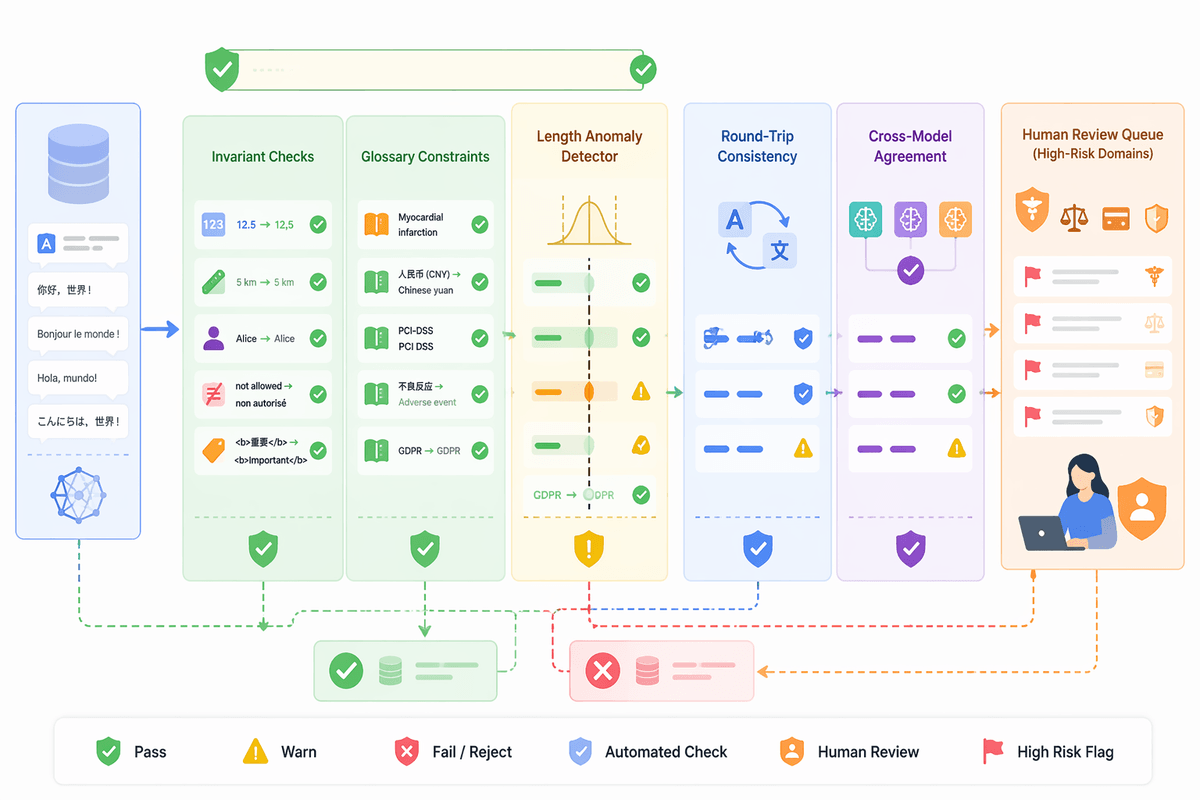
A realistic failure mode is celebrating “better BLEU” while the model quietly breaks the product: it mistranslates a key term, flips negation, drops a unit, or corrupts placeholders. Guardrails start with ruthless filtering. Reject synthetic pairs that fail invariant checks (numbers/units, entities, polarity markers, tags), violate glossary constraints, or show large length/structure anomalies. Add a cheap consistency gate such as round-trip agreement or cross-model agreement, then reserve human review for the small slices with the highest downside (medical/legal strings, payments, safety UI, anything with templating).
Evaluation needs to be slice-based, not averaged. Keep a frozen, human-verified set that over-represents the things you care about: terminology, entities, negation, formatting, and domain templates. Track a few targeted metrics (placeholder exact-match rate, term accuracy, numeric fidelity) alongside a small LLM-as-judge or MQM-style audit for adequacy. When a regression appears, quarantine the synthetic batch that caused it, lower its weight, and add “hard negatives” so the model learns what not to do.
A practical rollout plan for real translation systems
A rollout that works in production usually starts small: pick one domain and one language pair, define invariants (numbers, units, entities, placeholders), and build a frozen, human-verified eval set that overweights those cases. Run one baseline fine-tune on your current parallel data, then add a single synthetic stream (often constrained back-translation) with a strict cap on volume and weight.
Ship behind a gate: route a thin slice of traffic, log invariant violations and terminology misses, and require a “no-regression” bar on the frozen set before expanding. Budget for iteration costs—generation, filtering, and review time—and plan to periodically refresh synthetic batches so you don’t lock in one generator’s quirks or teach brittle formatting habits.