Why object understanding needs more than bounding boxes
A bounding box answers one question: “where is something?” Most product requirements quietly ask several more: “what is it called in my domain,” “is it the right instance,” “what state is it in,” and “how does it relate to nearby things?” A detector can draw a tight box around “cup” while missing that it’s cracked, empty, upside down, or the one the user actually pointed at. Boxes also hide ambiguity: a “charger” might be a wall adapter, a cable, or a dock, and the label set you trained on decides what’s “correct.” Expanding understanding beyond boxes usually means more data, more labels, and more edge-case rules, which gets expensive fast.
What visual-language models add beyond standard vision backbones

A common pain point with standard vision backbones is that their “world” is the label set you trained on. If you didn’t name “espresso tamper” or “USB-C hub,” the model can still produce features, but it can’t easily connect those features to language your team uses. Visual-language models change that by learning an aligned space where images and text meet, so you can ask, “does this look like this phrase?” and get a scored match without retraining a classifier head for every new name.
That alignment also helps with variation: “red ceramic mug,” “half-full paper cup,” or “broken handle” can be expressed as text and tested, instead of baked into a fixed taxonomy. The trade-off is real: prompts are brittle, performance drops on niche domains, and you may pay in latency or infrastructure if you run a large model in the loop.
Open-vocabulary recognition: naming the thing you didn’t label
You see the open-vocabulary problem any time the business asks for “the thing users mean,” not “the thing we trained.” A retailer’s catalog changes weekly, an IT team adds new device types, a safety program discovers a new kind of hazard sign. With a closed-set classifier, every new noun becomes a mini-project: collect examples, label them, retrain, and hope the new class doesn’t confuse the old ones. VLM-style recognition shifts that loop by letting you score candidate names directly: “handheld label maker,” “portable barcode scanner,” “embossing tape,” even if none were explicit training labels.
The practical gain is coverage and iteration speed. You can start with a long tail of text labels, measure where confidence is usable, and only label data where it isn’t. The constraint is that “can name it” isn’t the same as “can distinguish it”: fine-grained categories (two similar hubs, two nearly identical pills) often collapse without domain images, careful phrasing, or a small supervised adapter to tighten the decision boundary.
Attributes and relationships: from “what” to “what about it”
In many applications, the noun is the easy part. Support wants to know whether the laptop is closed or open, compliance needs whether a hard hat is worn or carried, and logistics cares whether a label is peeling or clean. These are attributes: properties of an object that often change within the same category. VLM-style text matching lets you test those properties directly (“mug with a chipped rim,” “box is crushed”), which can reduce the number of bespoke attribute heads you maintain.
Relationships show up when one object changes the meaning of another: “battery inside device,” “spill under sink,” “knife on cutting board,” “cable connected to monitor.” VLMs can score these composed phrases, but the difficulty is that relationships are spatial and often subtle. A high score may come from co-occurrence (“knives” often near “boards”) rather than the specific relation you need, so you still need targeted evaluation data and, sometimes, a lightweight model that explicitly reasons over geometry.
Grounding and localization: connecting words to specific pixels
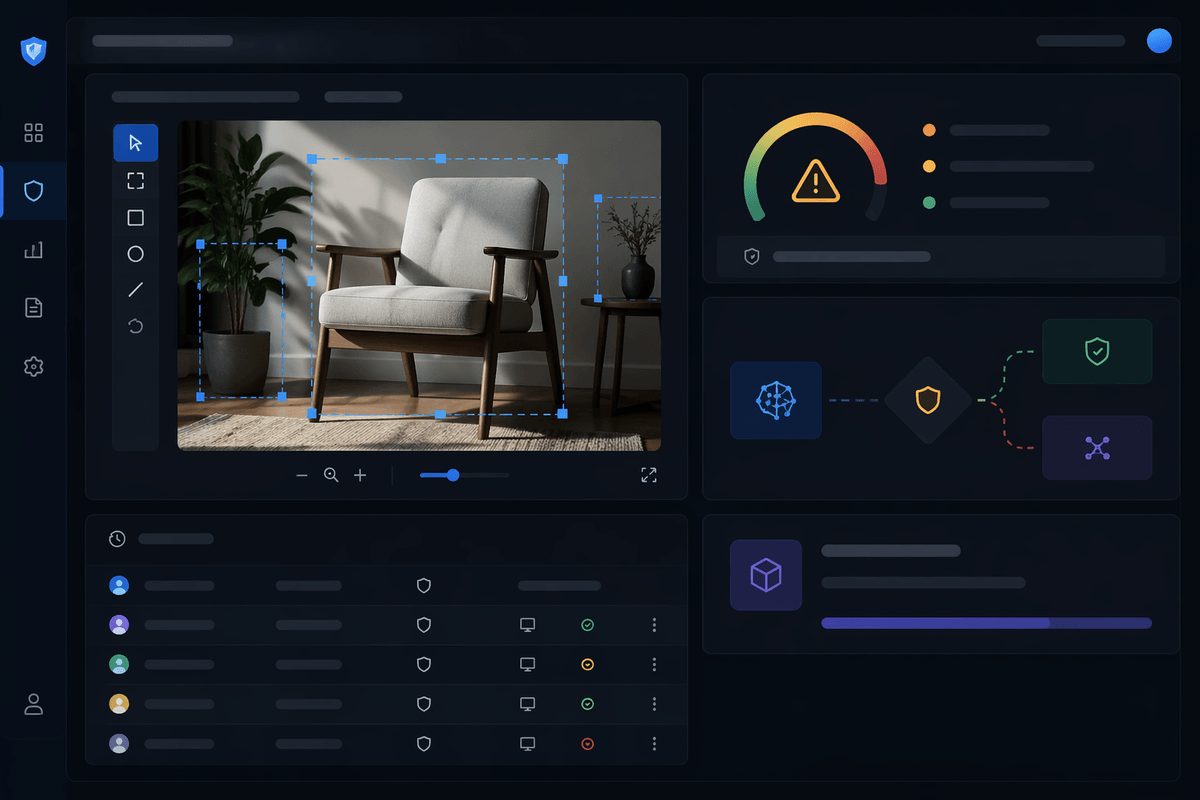
A common failure mode with “text-scored” recognition is that it’s right for the wrong reason: the photo gets a high score for “knife on cutting board,” but the knife is barely visible and the model is reacting to the board texture. Grounding and localization push the model to answer a harder question: “which pixels support that phrase?” That can look like a box, a point, or a segmentation mask tied to a caption-like query (“the chipped rim,” “the peeling label,” “the cable connected to the monitor”).
This matters in products because users care about the specific instance, not the general scene. If you highlight the wrong cup, the experience fails even if the category score was correct. Grounding also helps debugging: you can see whether “cracked screen” is triggered by the actual crack or by glare.
Pixel-level grounding is slower than pure embedding matching, and small errors are hard to notice until you test on clutter, occlusion, and unusual camera angles. Many teams end up mixing approaches: fast retrieval to propose candidates, then a smaller, task-tuned localizer to confirm and place the highlight.
Measuring improvement without fooling yourself with benchmarks
You can ship a model that looks “better” on paper and still lose in the product. Classic benchmarks reward the average case on tidy datasets; VLM-style gains often come from broader label coverage and better phrasing sensitivity, which those benchmarks don’t measure. A strong score on “open-vocabulary” can hide the fact that the model succeeds by picking up background shortcuts (kitchen counter → “knife”) or by matching brand text rather than the object itself.
Measure where you actually bleed: long-tail nouns, confusing near-duplicates, and attribute states that matter operationally (“sealed” vs “unsealed,” “connected” vs “near”). Use slice-based test sets built from your own images, and keep “hard negatives” that look similar but should not match the phrase. When you evaluate grounding, don’t just ask “did it find a region,” ask whether the highlighted region is the instance a user meant.
This kind of evaluation costs time and labeling money. It’s still cheaper than discovering in production that prompt tweaks changed behavior, or that a benchmark win didn’t reduce the support tickets you actually care about.
Using VLMs in products: prompts, adapters, and guardrails
In a real product, the first “model choice” is often a language choice: what phrases your system will allow, how you template them, and how you keep them stable over time. Small wording shifts (“USB-C hub” vs “multiport adapter”) can move scores enough to flip decisions, so teams end up treating prompts like configuration with versioning, tests, and a rollback path. It also helps to constrain the space: pick a controlled vocabulary, include a few negative prompts (“not a cable”), and calibrate thresholds per slice instead of hoping one global cutoff works.
When zero-shot is close but not dependable, adapters are the pragmatic middle ground. A small supervised head, LoRA-style tuning, or a retrieval layer over your own labeled images can tighten boundaries for near-duplicates without rebuilding a full detector taxonomy. You still pay for data, but you buy leverage: a few hundred domain examples can fix what thousands of generic captions won’t.
Guardrails are non-negotiable because VLM outputs are easy to over-trust. Require localization for high-impact actions, add “I’m unsure” states, log prompts and scores for audit, and design fallbacks to classic models when latency budgets or safety requirements demand predictable behavior.
A practical takeaway: where VLMs truly improve object understanding
You’ll feel VLMs help most when the product keeps changing its nouns and qualifiers faster than you can label them: new SKUs, new device types, new “states” that matter to users. They’re a strong fit for search, triage, QA, and “point me to the thing that matches this description,” especially when you can accept an “unsure” outcome and route to a fallback.
They’re a weaker fit when you need airtight, fine-grained separation (near-identical parts), strict geometry (exact “inside/attached” rules), or tight latency on-device. Plan for ongoing prompt/version management, slice-based evaluation, and some supervised adaptation. Treat VLMs as a leverage tool for coverage and iteration speed, not a replacement for task-specific detectors.