Why “confidently wrong” is the reliability problem
You ship a model that “looks accurate” in offline metrics, then a week later support tickets pile up: the assistant recommends the wrong refund policy, the classifier approves a risky document, the summarizer invents a quote. The common thread isn’t that the model is sometimes wrong—that’s expected. It’s that it’s wrong while sounding certain, leaving your product with no natural place to slow down, ask for help, or fail safely.
That failure mode breaks the usual engineering playbook. Retries don’t help. Better prompts don’t reliably fix edge cases. A single global threshold rarely matches the uneven risk across users, languages, and rare inputs.
Uncertainty estimation matters because it turns silent failure into a decision signal: trust, defer to a human, request more context, or abstain. The practical cost is real—latency, labeling, review queues—but it’s often cheaper than debugging incidents you couldn’t predict from accuracy alone.
What uncertainty is (and what it isn’t) in AI outputs
You already have “confidence” in most models: a softmax probability, a logit margin, a generation score. Uncertainty estimation is the extra step of treating that number as a hypothesis to be tested and calibrated against reality, so it can drive actions. In practice, it means producing a signal that correlates with error rate on the kinds of inputs your product actually sees, not just on the training distribution.
It also helps to separate two common sources. Aleatoric uncertainty is irreducible noise or ambiguity in the input (“this photo is too blurry,” “the policy text is contradictory”). Epistemic uncertainty is the model’s lack of knowledge (“this document type never appeared in training,” “this language mix is rare”). Many systems only expose one blended score, so you have to validate what it truly tracks.
Uncertainty isn’t a guarantee of correctness, and low uncertainty isn’t a warranty. It’s a ranking tool: which items deserve review, which need more context, and where to set risk-based thresholds. Getting it wrong has costs—unnecessary human queues if it’s overcautious, and silent failures if it’s overconfident.
Where uncertainty estimates pay off in real workflows
A familiar pattern is shipping a model into a workflow that already has “escape hatches”—a review queue, a secondary check, or a way to ask the user a clarifying question—but lacking a principled trigger for when to use them. A usable uncertainty signal lets you reserve those escape hatches for the cases most likely to be wrong: route high-uncertainty refund-policy answers to a specialist, send borderline KYC documents to manual review, or ask for a clearer photo instead of guessing. In generation, it can gate tool calls (“don’t execute a payment change if uncertainty is high”) or force citation-backed responses only when the model is most at risk of hallucinating.
It also pays off in monitoring. If the fraction of high-uncertainty inputs spikes after a product launch, a new locale, or a vendor schema change, you get an early warning even before labels arrive. Someone must own thresholds, backlog, and turnaround times, and uncertainty that isn’t calibrated to your traffic can just shift cost into an expensive human queue.
Picking an estimation method: simple baselines to stronger options
A common starting point is to treat uncertainty as “how close was the decision?” For classifiers, that can be max softmax probability, logit margin, or entropy. For LLM generation, teams often use average token logprob, self-consistency across a few samples, or simple heuristics like “did retrieval find anything relevant?” These baselines are cheap and fast, and they often rank easy vs. hard cases reasonably well. The downside is they’re rarely calibrated: a 0.9 score may not mean “90% correct” once you change prompt templates, class balance, or user mix.
The next step up is calibration on held-out data that matches production: temperature scaling, isotonic regression, or Platt scaling for classifiers, and lightweight learned risk models for LLM outputs (using features like logprobs, retrieval overlap, tool errors, input length, and policy triggers). These are still operationally simple, but they require labels that reflect real traffic and periodic refresh as distributions shift.
When stakes or distribution shift risk is high, epistemic-focused methods can be worth it: deep ensembles, MC dropout, Bayesian last-layer approximations, or conformal prediction for coverage guarantees. They typically cost more (multiple forward passes, more memory, more training complexity), so they’re best reserved for high-impact decisions where an extra 50–200ms or added infra is cheaper than a bad automated action.
How to tell if your uncertainty is actually reliable
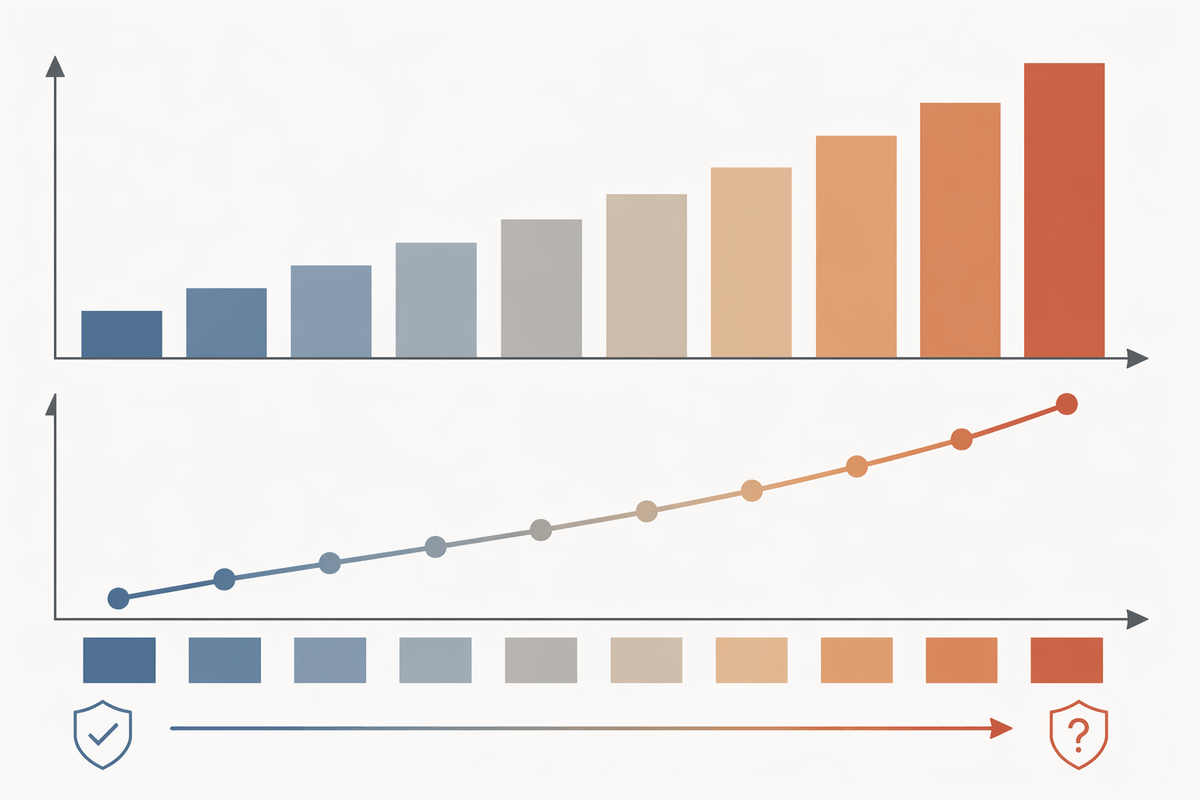
You can’t validate uncertainty by looking at scores alone; you validate it by checking whether “higher uncertainty” actually means “higher error rate” on your traffic. Start with a labeled slice that matches production (recent, same prompts/templates, same routing) and bucket predictions by uncertainty. In each bucket, compute observed accuracy (or task-specific loss) and confirm it’s monotonic. If your “most confident” decile is only slightly better than the middle, the signal won’t buy you much, even if the model’s overall accuracy is fine.
Calibration is the stricter test: when the system says 80% confidence, is it correct about 80% of the time? Reliability diagrams, expected calibration error (ECE), and simple Brier score comparisons make this concrete. For abstention workflows, plot a risk–coverage curve: as you defer more (higher uncertainty threshold), does residual error drop predictably, and does it drop enough to justify queue cost and latency?
Finally, stress it under change. Re-run the same checks across segments (locale, input length, new vendors) and over time; uncertainty often “looks good” on last month’s distribution and quietly degrades after a product shift.
Designing decisions around uncertainty, not just displaying it
A common anti-pattern is shipping uncertainty as a UI badge (“low/medium/high”) without changing what the system does. The value comes when you turn the score into routing: below a threshold, auto-act; in the gray zone, ask a targeted follow-up (“Which plan are you on?”); above it, abstain or send to review. Make the threshold depend on outcome risk, not model type—mislabeling a support ticket is cheap, misrouting a funds transfer is not.
Every percent of additional coverage you automate has a cost in expected errors, and every percent you defer has a cost in queue load, latency, and reviewer time. Put those costs in the same units when you can (refund dollars, analyst minutes, compliance hits), then pick thresholds that minimize expected loss.
Keep uncertainty “close to the action.” Tie it to safeguards like step-up verification, tool-call permissions, or requiring citations. When you change prompts, retrieval, or post-processing, re-tune thresholds, because the score distribution shifts even if accuracy doesn’t.
Common pitfalls: when uncertainty can mislead or drift
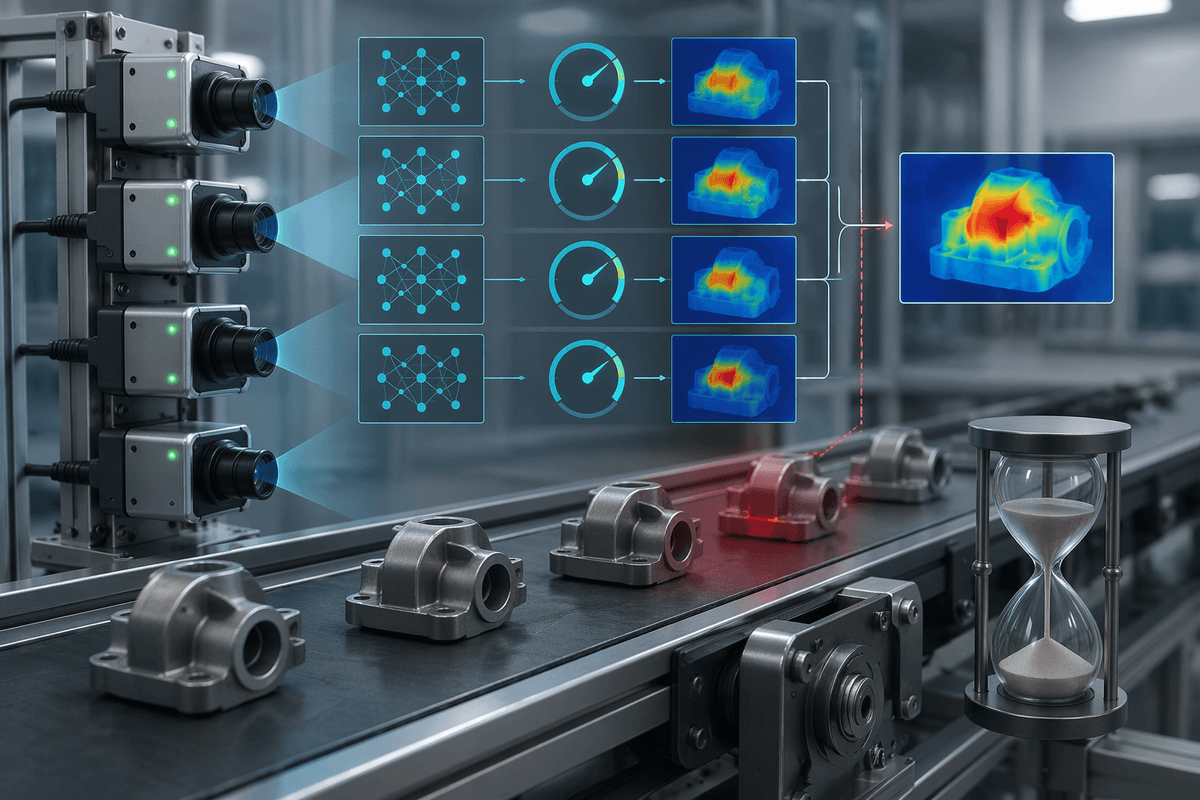
A familiar trap is treating one uncertainty number as portable. Scores that were calibrated on last month’s traffic can become misleading after a prompt change, a new retrieval index, or a rollout to a new locale. You’ll still see a nice-looking distribution of “high/low,” but the mapping to error rate breaks, so routing decisions quietly degrade.
Another pitfall is proxy uncertainty: the model is “uncertain” about long inputs, rare formats, or low-retrieval overlap, but those features may correlate with user segment rather than true error. That can create systematic deferral of certain customers and an expensive review queue that doesn’t actually reduce risk. Ensembles and sampling can help, but if the members share the same blind spots, you just pay extra latency for correlated confidence.
Finally, uncertainty signals can drift due to feedback loops. If reviewers only label deferred cases, your calibration set becomes biased, and the model can look better calibrated than it is on auto-approved traffic. Monitoring needs segment-level calibration checks, not just overall ECE.
A practical path to shipping uncertainty without boiling the ocean
You can usually ship something useful in two sprints without rebuilding your model stack. Pick one high-impact decision point (approve vs. review, tool-call vs. refuse) and start with a cheap score you already have (margin, entropy, logprob features). Calibrate it on a recent, production-matched labeled slice, then set one risk-based threshold that buys you clear operational leverage.
Wire the threshold into routing, not UI: a small gray zone that triggers a single clarifying question or a review queue, plus an explicit abstain path. Track a risk–coverage curve, queue volume, and segment-level calibration weekly, and re-tune after prompt/retrieval changes. The real constraint is owning the workflow: reviewers, SLAs, and label leakage, not the math.