Why material discovery AI is showing up in structural design
Teams doing structural design keep running into the same wall: topology optimization and careful FEA can only do so much if you’re locked into last year’s alloy list, a supplier’s composite layup menu, or a conservative design allowables table. The fastest path to lighter, stiffer, longer-life parts often isn’t a new shape—it’s a slightly different material system that changes what “safe” and “efficient” look like.
Material discovery AI shows up here because it can screen candidate chemistries, heat treatments, microstructures, and process windows using a mix of lab data and physics-based simulations, then hand design engineers plausible property ranges to test in their load cases. Instead of guessing, you get a ranked set of options tied to targets like modulus, fatigue strength, corrosion resistance, or cost.
The model is only as credible as the data provenance, the processing assumptions, and the manufacturability constraints you enforce. Early results often require new coupons, supplier engagement, and time for allowables—so the “faster” loop still has real test and qualification costs.
When new materials actually change your design constraints
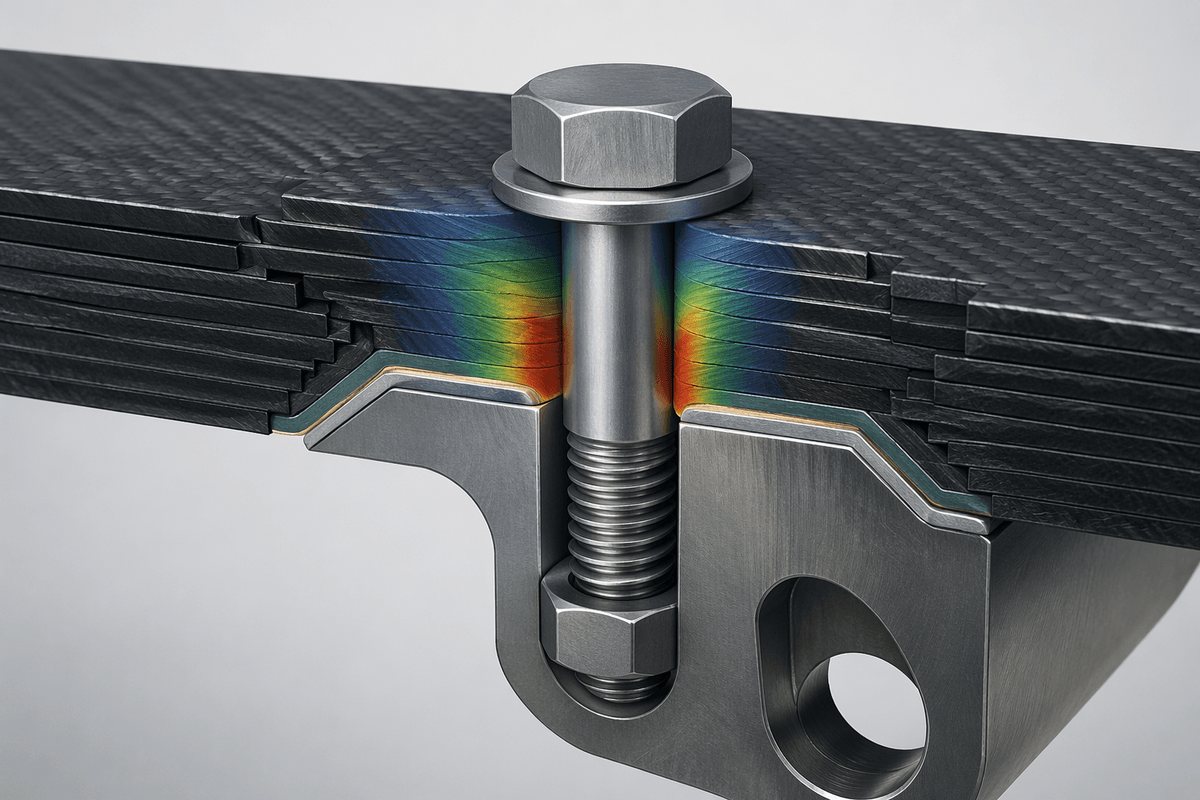
Most “new material” candidates don’t change structural design much because they move a single headline number while leaving the real constraints—fatigue knockdowns, temperature limits, corrosion margins, joinability, and inspection requirements—roughly the same. What actually changes your feasible design space is when the material shifts a governing allowable (for example, higher fatigue strength at your mean stress), or removes a penalty you’ve been designing around (like galvanic corrosion at a joint or creep at service temperature).
That’s why the right question isn’t “is it stronger,” but “which constraint stops being active.” A tougher matrix system might let you reduce ply drops or increase bearing strength in bolted regions; a different heat treatment might raise notch sensitivity concerns and force gentler radii; an AM-tuned alloy might improve stiffness-to-weight but introduce anisotropy and new inspection costs. The material only “wins” if those second-order constraints are modeled, then verified with the tests you can actually afford.
The minimum data and physics you need to start
You usually already have enough to start if you can answer three things with evidence: what loads matter, what failure modes govern, and what processing route you’re willing to certify. The minimum dataset is rarely “big”; it’s consistent. A few dozen well-documented coupon results per material/process variant (elastic modulus, yield/ultimate, fatigue S–N or crack growth, and temperature/moisture sensitivity if relevant) plus metadata on heat treat, layup, AM parameters, or batch history often beats a larger pile of mixed-quality points.
On the physics side, you need just enough structure to keep the model from proposing “good numbers” that violate reality: bounds from thermodynamics/phase stability, simple micromechanics for composites, and process-aware knockdowns for anisotropy, porosity, residual stress, or surface condition. If you can’t connect predicted properties to a manufacturable window, the optimizer will drift toward solutions that look brilliant in FEA and fail at procurement or qualification.
Co-optimizing material and structure without chasing nonsense solutions
A familiar failure mode is letting the optimizer “discover” a material that makes the structure look perfect in FEA because the inputs were treated as independent knobs. If modulus, fatigue strength, density, and allowable strain can all float freely, you’ll get impossible combinations. The fix is to optimize over linked decision variables: composition + process window + microstructure state, with properties generated from that state (or drawn from bounded, correlated distributions).
Do the structural search on top of that, but keep it honest: include manufacturing constraints (minimum gauge, draft, ply steering limits, AM build direction), join and inspection rules, and the load cases that trigger damage tolerance or durability requirements. Use robust objectives—minimize mass at a target reliability—so a narrow, high-performing prediction doesn’t win if it collapses under variability.
The “best” co-optimized candidates often require new coupons and a supplier process capability study before they’re designable, not just promising.
Picking the right AI approach for your maturity level

You can usually tell what AI you need by what you already trust. If your team mainly trusts handbook allowables and a few qualified suppliers, start with AI as a screening layer: fit uncertainty-aware surrogate models on your existing coupon data, constrain candidates to your approved process families, and use active learning to decide which 10–30 new coupons buy the most reduction in design uncertainty.
If you already run strong FEA workflows and have decent metadata (heat treat, layup, AM parameters, batch history), you can move to hybrid models that use physics-based features and enforce property correlations, then feed distributions into reliability-based optimization. That tends to improve weight and durability decisions without pretending you’ve “discovered” a new alloy.
Jumping straight to generative discovery only makes sense when you can budget for iteration: lab throughput, supplier process studies, and qualification lead times. Otherwise the model will produce candidates you can’t buy, make, inspect, or certify.
How you validate: from simulations to coupons to component tests
A model can rank material/process candidates, but validation starts where your design decisions start: in the same load cases, boundary conditions, and failure criteria your team already signs. Run sensitivity checks first—if small shifts in modulus, S–N slope, or yield move the design from pass to fail, treat predictions as distributions and propagate uncertainty through FEA rather than freezing “best guess” properties.
Then close the loop with coupons that match the proposed processing window and surface condition. Prioritize tests that bind your active constraints (fatigue, bearing/bypass, crack growth, environmental knockdowns), and record metadata tightly enough that you can explain variance. Component tests come last and should target the exact features that models miss: joints, thickness transitions, residual stress, and inspection-driven defects. The practical limit is time and budget—coupon plans and fixture design often dominate the schedule more than the AI training step.
Toolchain reality: CAD/FEA integration, traceability, and governance
In practice, the “AI result” has to land as something your CAD/FEA stack can consume: a material card with units, temperature/strain-rate dependencies, allowable definitions, and a clear mapping to the failure criteria your solvers use. If that handoff is manual, you’ll get silent errors—wrong coordinate systems for anisotropy, mixed allowables, or properties pasted into the wrong analysis deck.
Traceability matters as much as accuracy. Treat every candidate as a configuration item: which coupon lots trained the model, which processing window was assumed, what uncertainty bounds were exported, and which FEA runs used them. Store that provenance in PLM/requirements tools alongside the geometry and analysis revisions, not in notebooks and shared drives.
Governance is mostly about decision rights and audits: who can promote a predicted material from “screening” to “design input,” what validation gate is required, and how supplier data is handled. The unglamorous cost is integration work—schemas, APIs, access control, and review workflows often take longer than model training.
A practical way to start small and still get value
A sensible pilot starts with one part you already understand: stable load cases, clear failure drivers, and a real business target (mass, cost, life, or corrosion margin). Pick 2–3 “nearby” material/process variants you could plausibly source—new heat treat, modified composite resin, an AM parameter window—and treat AI as a way to rank them with uncertainty, not to invent a miracle material.
Build a thin loop: export correlated property distributions into your existing FEA, run robustness checks, then buy a small coupon plan aimed at the governing constraint (often fatigue, bearing, or environment). If results can’t be turned into a material card, procurement spec, and a test report your reviewers accept, it’s not value yet—and the integration work is a real cost you should budget up front.