When nonsense looks plausible, and the model still commits
You’ve probably seen a model take a garbled prompt, a half-corrupted image, or a table full of typos and still produce a polished, decisive answer. That isn’t a “bug” in the narrow sense; it’s a predictable result of building systems that are optimized to always output the most likely completion, label, or category. When the input is nonsense but resembles something it has seen—maybe the shape of a medical code, a headline, or a product spec—the model often snaps it to the nearest familiar pattern and commits.
The trouble is that many ML pipelines reward decisiveness. Classification models must pick a class, ranking systems must order items, and generative models are trained to keep going. In real products, silence is costly: users expect an answer, and “I don’t know” may look like failure. So when the input is ambiguous or meaningless, the model still produces a best guess, and the surrounding UX can accidentally make that guess look authoritative.
This gets worse when the nonsense is plausibly structured. Random strings with punctuation, realistic dates, or domain-like terminology can trigger strong associations even if the content is wrong. It’s the same reason a fake invoice that “looks right” slips through a quick glance. Detecting nonsense reliably often requires extra steps—verification calls, human review, or conservative thresholds—and those add latency, cost, and sometimes friction that teams hesitate to accept.
Pattern matching isn’t understanding, even when outputs feel meaningful

Think about how you can skim a sentence full of typos and still “get it.” Models do something that can look similar, but it’s mostly statistical association, not comprehension. They learn that certain words, formats, and cues tend to travel together, then reproduce those links. If a prompt contains the usual scaffolding of a real request—an error log shape, a clinical-sounding phrase, a JSON blob—the model can assemble an answer that matches the style and typical next steps, even if the underlying claim is incoherent.
That’s why the output can feel meaningful: it mirrors how explanations, diagnoses, or summaries usually sound. But it doesn’t have a built-in way to check whether the “story” is grounded in reality unless you provide one (tools, retrieval, constraints, validation rules). Without that, the model can be fluent and wrong at the same time. Adding grounding helps, but it introduces new costs: integration effort, slower responses, and more ways a system can fail when a dependency is down.
Training data teaches shortcuts that break on weird inputs
Watch what happens when you feed a system inputs that look “almost right”: a shipping label with one field swapped, a résumé with unusual formatting, a lab value written in a rare unit. During training, models are rewarded for picking up shortcuts that work most of the time—like “this phrase usually implies that category” or “this layout usually means that intent.” Those shortcuts are efficient because they match the dominant patterns in the data, and they often outperform slower, more literal reasoning.
If the training data over-represents certain templates, brands, dialects, or error types, the model may lean on those cues instead of the underlying meaning. That’s when weird inputs break it: the model grabs the nearest familiar cue and fills in the rest, even if the cue is accidental.
Fixing this usually means changing what the model sees and what you reward: adding counterexamples, rebalancing edge cases, and testing against “near-miss” inputs. That work is expensive because it requires curated data, domain expertise, and ongoing updates as real-world formats drift.
Out-of-distribution nonsense triggers confident but unstable guesses
A lot of the scariest failures show up when an input falls outside the model’s training distribution—meaning it doesn’t resemble the mix of examples the model learned from. The system still has to map that unfamiliar thing onto familiar categories or continuations, so it “projects” structure where there may be none. A spam filter might treat a chunk of base64 as a marketing email. A support triage model might assign a ticket to “billing” because it recognizes a few money-like tokens, even if the rest is noise.
Out-of-distribution prompts also make behavior less stable. Small, meaningless edits—changing a delimiter, swapping two random words, adding a stray character—can flip the answer because the model is balancing on weak associations. You see this in practice when a model seems consistent on normal traffic but becomes unpredictable on corrupted logs, OCR glitches, or adversarially perturbed text.
It’s hard to “fix” this with a single knob. Detecting distribution shift usually requires extra instrumentation and reference data, and those checks add compute, latency, and ongoing maintenance as your inputs evolve.
Tokenization and embeddings can turn gibberish into familiar shapes
You’ve also got a quieter reason nonsense can look meaningful: the model doesn’t read text as you do. It breaks inputs into tokens—often fragments like “bio”, “##log”, “202”, “-07”—and then maps those tokens into embeddings, where “similar” pieces land near each other. A weird string like “inv#2026-07__bio-log” can end up sharing token parts with real invoices, dates, and biology terms, even if the overall input is garbage.
Once those pieces are in a familiar neighborhood, the model can assemble a plausible continuation from nearby patterns: invoice language, lab-report formatting, common troubleshooting steps. This is especially noticeable with typos, OCR artifacts, code-like punctuation, and mixed-language text, where token boundaries get messy and accidental overlaps become common.
You can’t easily “eyeball” what the model sees without tooling. Token inspection, normalization rules, and input constraints help, but they take engineering time and can reject legitimate edge-case users.
“Confidence” scores often aren’t calibrated to reality
In many products, a single number gets treated as a truth meter: the model says “92%,” so it must be safe to act. But most ML “confidence” signals are not a direct probability that the answer is correct in the real world. For classifiers, the score often reflects how strongly the model prefers one label over the others, given its internal features. For generative systems, “confidence” is even murkier: token probabilities can be high while the overall claim is false, because the model is confident about what usually sounds like the next sentence.
Calibration breaks hardest exactly where you care most: on edge cases, distribution shift, and structured nonsense. The model can be very “sure” because the input accidentally activates familiar cues, even if the underlying content is meaningless. Tightening thresholds helps, but it trades off coverage and user experience. You end up rejecting more legitimate-but-unusual inputs, and you still need a plan for what happens when the system is forced to answer anyway.
What you can do: tests, guardrails, and better evaluation
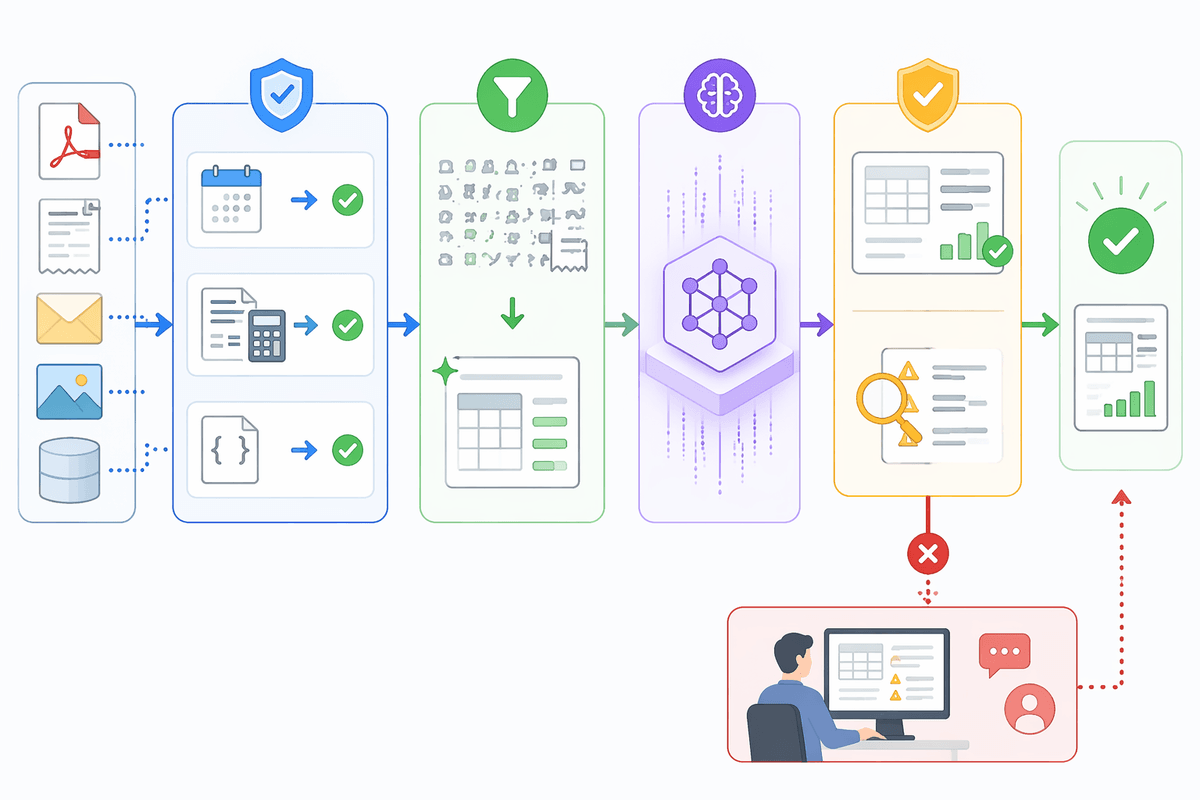
In a real product, the most effective move is to stop treating “normal traffic” as your test set. Build a small, repeatable suite of nasty inputs: corrupted OCR, swapped fields, random delimiters, near-miss IDs, mixed languages, and plausible-looking gibberish. Run it on every model change and every prompt/template change, because regressions often come from “harmless” edits. Measure instability too: does a one-character change flip the label, the routing decision, or the recommendation?
Guardrails work best when they’re boring and specific. Validate formats before the model sees them (dates, invoice totals, JSON schemas), normalize common noise, and refuse to act on outputs that can’t be verified. Add an abstain path that’s actually usable: route to human review, ask a clarifying question, or fall back to deterministic rules. For higher-stakes tasks, require citations to retrieved sources or tool outputs, and log when the model can’t support a claim.
Evaluation should reflect downstream cost, not just accuracy. Track false confidence: cases where the model sounds certain but fails validation, contradicts tools, or changes answers across tiny perturbations. This adds latency, labeling work, and operational overhead, but it makes “confident nonsense” visible before users do.
A practical takeaway: treat ML as a fallible pattern engine
In day-to-day use, it helps to treat ML like an autocomplete with opinions: useful, fast, and often right on familiar terrain, but not inherently tied to truth. When it meets structured noise, it will still produce the closest-looking pattern, and it may do so with the same polished tone you see on clean inputs. Design your product assuming that failure mode exists: separate “generate” from “decide,” require checks before taking irreversible actions, and make it cheap to say “need more info.” The trade-off is real—more validation, more fallbacks, and occasionally more user friction—but that’s the price of turning fluent guesses into dependable behavior.