When “uncertain conditions” break a confident AI decision
A model can look “certain” while the world is quietly changing around it. A fraud classifier that confidently blocks a customer’s card might be reacting to a new spending pattern, a missing merchant field, or a shifted user base after a pricing change. The score is still crisp; the inputs are not. That’s how you end up with decisions that are technically consistent with training data but operationally wrong.
The practical problem isn’t uncertainty in the abstract—it’s where it shows up in your decision pipeline: noisy labels, incomplete features, delayed outcomes, and feedback loops that your own actions create. Adding uncertainty handling is rarely free; it can slow latency, raise compute costs, and force new product states like “review” or “ask for more info.” The trade-off is fewer confident mistakes when conditions degrade.
Which kind of uncertainty are you actually facing?

The fastest way to make uncertainty actionable is to name what’s unstable. Some uncertainty is just noise: labels are wrong, sensors jitter, customers behave inconsistently, and your model’s error bars shrink if you collect more clean data. Another category is missingness: a key feature is blank, delayed, or inconsistently populated across partners, so the model is forced to guess from weaker signals. These two problems often look similar in metrics, but they call for different fixes—data quality work and calibration for noise, versus explicit “unknown” handling, imputation policies, or decision deferral for missingness.
The most expensive uncertainty usually comes from shift. The population changes, the product changes, adversaries adapt, or operations introduce a new workflow, and the training distribution stops matching reality. Your model can stay highly confident because it has no built-in reason to doubt familiar patterns. Treating shift like noise leads to brittle decisions and overtrust; treating noise like shift leads to constant retraining and churn. The goal is to detect which one you have early enough to change the decision rule, not just the model.
Probabilities aren’t decisions: what is the model optimizing?
A prediction like “0.92 fraud” is not a decision; it’s an input to one. The model is optimizing a training objective—often log loss or cross-entropy—which rewards probability accuracy on average, not the business outcome of each action. If the cost of a false decline is a churned customer and the cost of a missed fraud is a chargeback plus support time, the best threshold is rarely 0.5, and it may not even be a single threshold across all segments.
This mismatch shows up when teams treat probabilities as if they already encode preferences. A calibrated model can still be “wrong for the business” if the decision rule ignores asymmetric costs, capacity limits, and downstream workflows. Review queues have finite staff. “Step-up authentication” adds friction. Some actions are irreversible. A sensible policy often mixes a score threshold with constraints: block when the expected loss is high, route to review when uncertainty is high and capacity exists, and otherwise allow.
Getting this right requires making the optimization target explicit. Write down the loss function in business terms, decide which errors are acceptable in which contexts, and only then use probabilities to drive the action that minimizes expected harm under those constraints.
Picking a decision model: rules, scores, or sequential policies
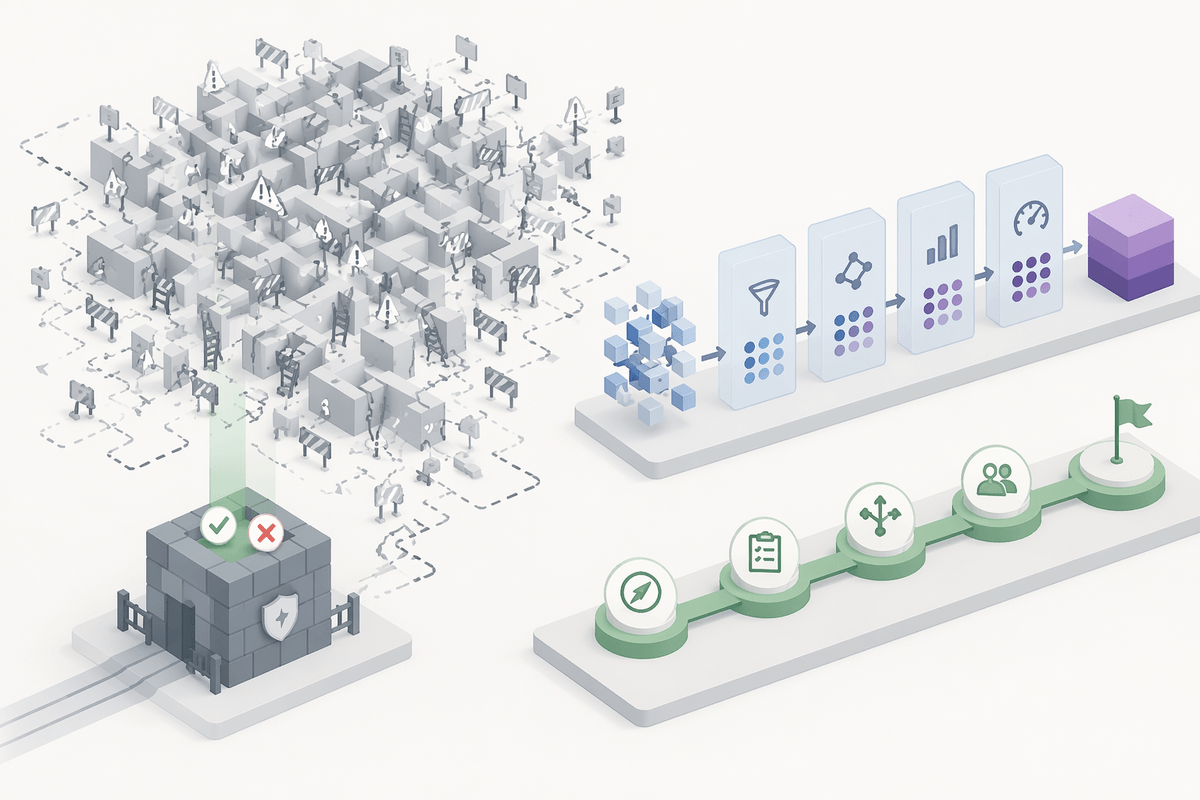
A common failure mode is treating every choice as “set a threshold and ship.” Sometimes that’s right: if regulation demands a deterministic explanation, or if the action is irreversible (closing an account), a small, auditable rules layer can be the safest first line. Rules work best when the inputs are stable and legible—hard limits, allowlists/denylists, policy constraints—and worst when they silently grow into a brittle exception library that no one can fully test.
Score-based decisions are the default because they scale: compute a risk score, apply thresholds that reflect costs, and optionally segment by context (new customer vs. long-tenured, high-value vs. low-value). The practical constraint is calibration drift: your “review band” can flood overnight after a product change, forcing either rushed threshold moves or backlogs that delay outcomes and degrade learning.
Sequential policies earn their keep when you can gather information before committing. Instead of “approve/deny,” the system can choose “ask for verification,” “request a missing field,” or “wait for an outcome signal.” You get better decisions under uncertainty, but you pay in latency, UX friction, and operational complexity—every extra step needs capacity, monitoring, and a clean fallback when the next signal never arrives.
How to represent uncertainty without overcomplicating the system
The familiar pattern is a team adding “Bayesian” or “ensemble” to the roadmap, then discovering the real problem was simpler: the system needed a way to say “I don’t know” in operational terms. Start by deciding what uncertainty should change in behavior. If the only available action is still approve/deny, richer uncertainty estimates often just create dashboard noise. If you can route to review, ask for more info, or apply a softer control, uncertainty becomes a lever.
The lowest-complexity representation is usually a small set of uncertainty-aware decision bands. Keep the base score, add one extra signal that captures reliability (calibration error by segment, missing-critical-fields flags, or disagreement across a small ensemble), and define a “defer” region where stakes are high and confidence is low. This avoids pushing every edge case into feature engineering.
Costs show up fast: ensembles increase latency and compute, and deferral creates queue management and customer friction. Treat uncertainty features like product surfaces—version them, test them, and cap how much they can change downstream volume before you ship.
Dealing with shifting conditions: robust choices and safe fallbacks
A common operational surprise is that the model isn’t failing everywhere; it’s failing in pockets created by change. A new onboarding flow, a payments partner outage, or a policy update can shift feature availability and user behavior in ways that don’t trigger a clean metric drop until damage is done. Robust decisioning treats those moments as expected: keep multiple “known-good” policies, and choose among them based on observed conditions (segment, missingness rates, upstream system health), not just the score.
Two practical tactics help without turning the system into a research project. First, add guardrails that bound the impact of drift: caps on auto-decline rates by segment, minimum evidence requirements (e.g., don’t take irreversible actions when critical fields are missing), and thresholds that tighten when uncertainty spikes. Second, design safe fallbacks that are operationally real: step-up verification, temporary allow with monitoring, or a conservative rules-only mode when upstream data quality drops. Each fallback has a cost—review capacity, fraud exposure, or UX friction—so the “safe” choice is the one you can sustain for days, not minutes.
Testing and monitoring: proving it works when it matters
You rarely get a clean offline answer to “will this decision policy behave under stress?” because the stress cases are sparse and changing. Treat evaluation as scenario coverage: backtest on known incidents (partner outages, launch weeks, fraud waves), slice by missingness and segment, and measure policy outcomes (loss, churn, review load), not just AUC. Run shadow mode for new logic so you can compare actions without impacting users, then stage rollout with hard volume and rate caps.
Monitoring has to match your failure modes. Track calibration and error rates by segment, drift and missing-field rates, queue backlog and time-to-decision, and “fallback frequency” as a leading indicator. Instrument alerts that page on sustained changes, not single spikes, and require an explicit rollback path that operations can execute in minutes. The constraint is cost: labeling, dashboards, and on-call time are part of the system, not overhead.